

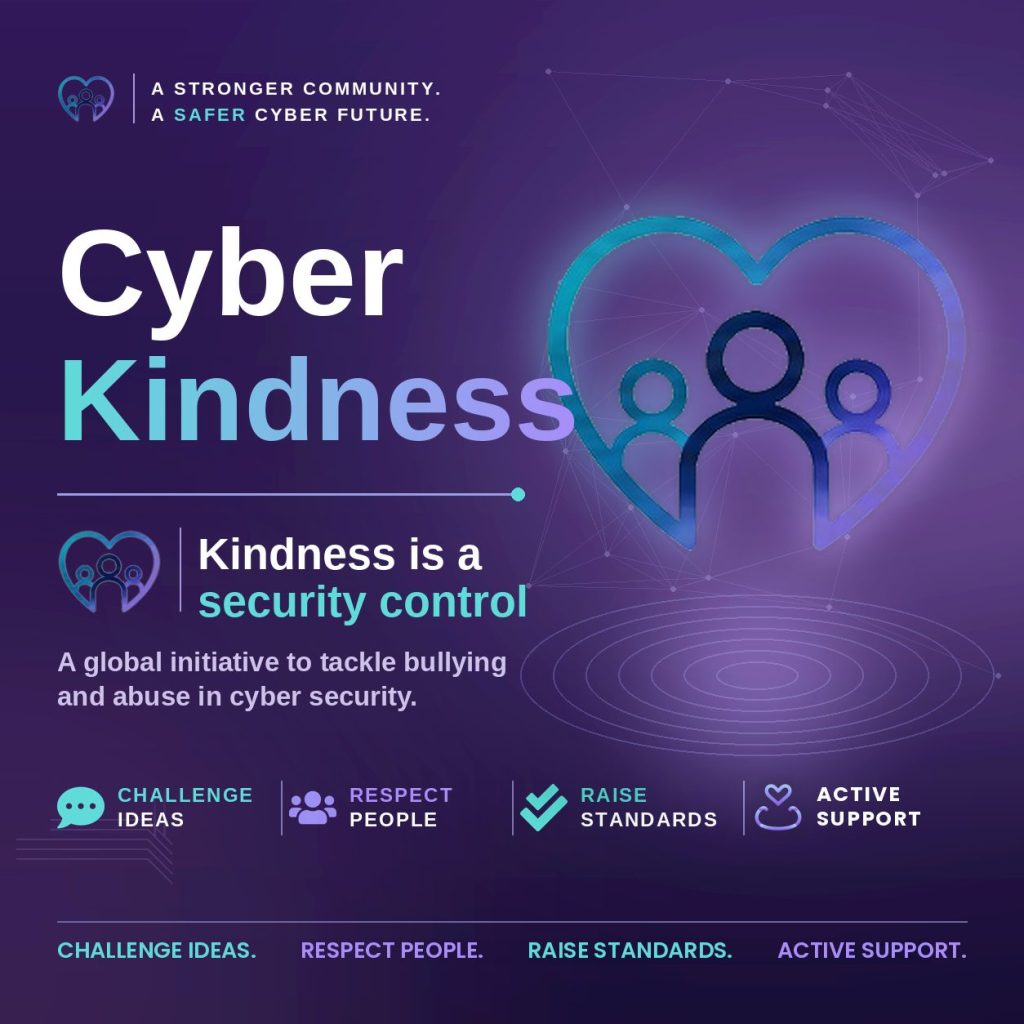
In August 2026, disillusioned with the amount of bullying, abuse and toxicity in the cyber security industry, I founded Cyber Kindness.
I had spent years watching good and capable people walk away from an industry they loved. Not because the work defeated them, but because of how they were treated while they did it. I had listened to a great many of those stories, and I had one of my own.
Cyber Kindness is a global campaign to tackle bullying, harassment and toxic behaviour in cyber security. It exists to raise professional standards, strengthen psychological safety and build an industry where people can own a mistake early, ask the obvious question and challenge each other’s thinking without first working out what it will cost them.
The pattern will be familiar to anyone who has spent time in this industry. Someone is talked over in a meeting until they stop contributing. Someone is corrected in public in a way that has nothing to do with the technical point being made. Someone new asks a question and learns very quickly not to ask another one. A researcher shares their work and is met with ridicule rather than rigour.
None of it is dramatic enough on its own to report. All of it adds up, and it adds up in a direction that makes us less safe.
Cyber security depends on people noticing what others miss, admitting mistakes quickly and questioning assumptions before those assumptions turn into incidents. Every one of those behaviours asks someone to speak up when staying quiet would be easier.
An organisation where people are afraid of how they will be treated is an organisation that hears about its problems late. The person who clicked the link says nothing for three days. The analyst who spotted something odd decides it is not worth the reaction. The engineer who does not follow the change nods along rather than admit it. Culture is not a soft consideration sitting alongside the technical controls. It determines whether those controls ever get the information they need.
That is why I say kindness is a security control.
This matters well beyond how it feels to work here. Cyber security depends on people noticing what others miss, admitting mistakes quickly and questioning assumptions before they turn into incidents, and none of that happens when people are afraid to speak. An organisation where people fear the reaction is an organisation that hears about its problems late. Kindness is a security control.
Cyber Kindness is for every person in this industry. Men are bullied, harassed and stalked just as much as women are, as are people of every background and level of experience, so when we treat safety as one group’s problem we let everyone else down.
The campaign is open to individuals and organisations through the Cyber Kindness Pledge, an Ambassadors programme and a growing set of free resources for workplaces, educators, events and communities.
Visit www.cyberkindness.org.uk to find out more.